
Technology
Full-Stack Processing
Hear360 licenses studio-grade processing for both sides of the audio chain: spatial rendering and output processing for playback — voice processing for capture. The signal chain is configured in the Hear360 Workstation.
The Hear360 Workstation
Signal chain design, module library, and parameter tuning
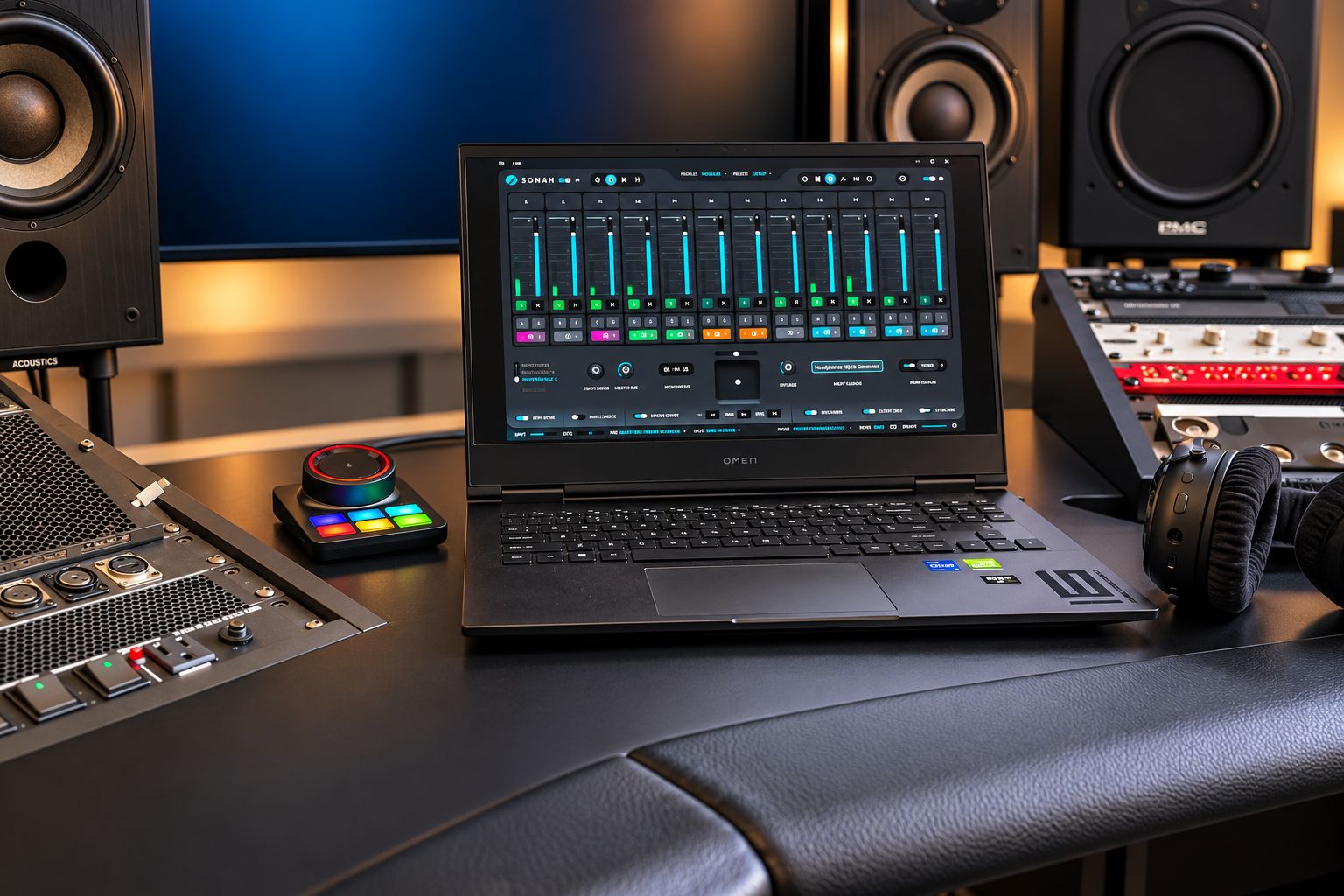
The Hear360 Workstation holds the full processing portfolio in one environment. Signal chains are designed and tuned here, then run on the target through the Hear360 runtime engine.
- The IP portfolio. Every Hear360 module, from spatial rendering to the voice chain.
- Signal chain design. Turnkey chains, or custom chains built to customer requirements.
- Mix UI. Parameter tuning with live visualization and metering at every stage.
- True bypass. Global, chain and module bypass for comparison with the unprocessed signal.
- Profiles and presets. Whole-system states, and module tunings reused across products.
- Transducer data. Impulse responses, SOFA HRTFs and SPL calibration load directly.

Spatial audio
Surround and height, imaged on headphones
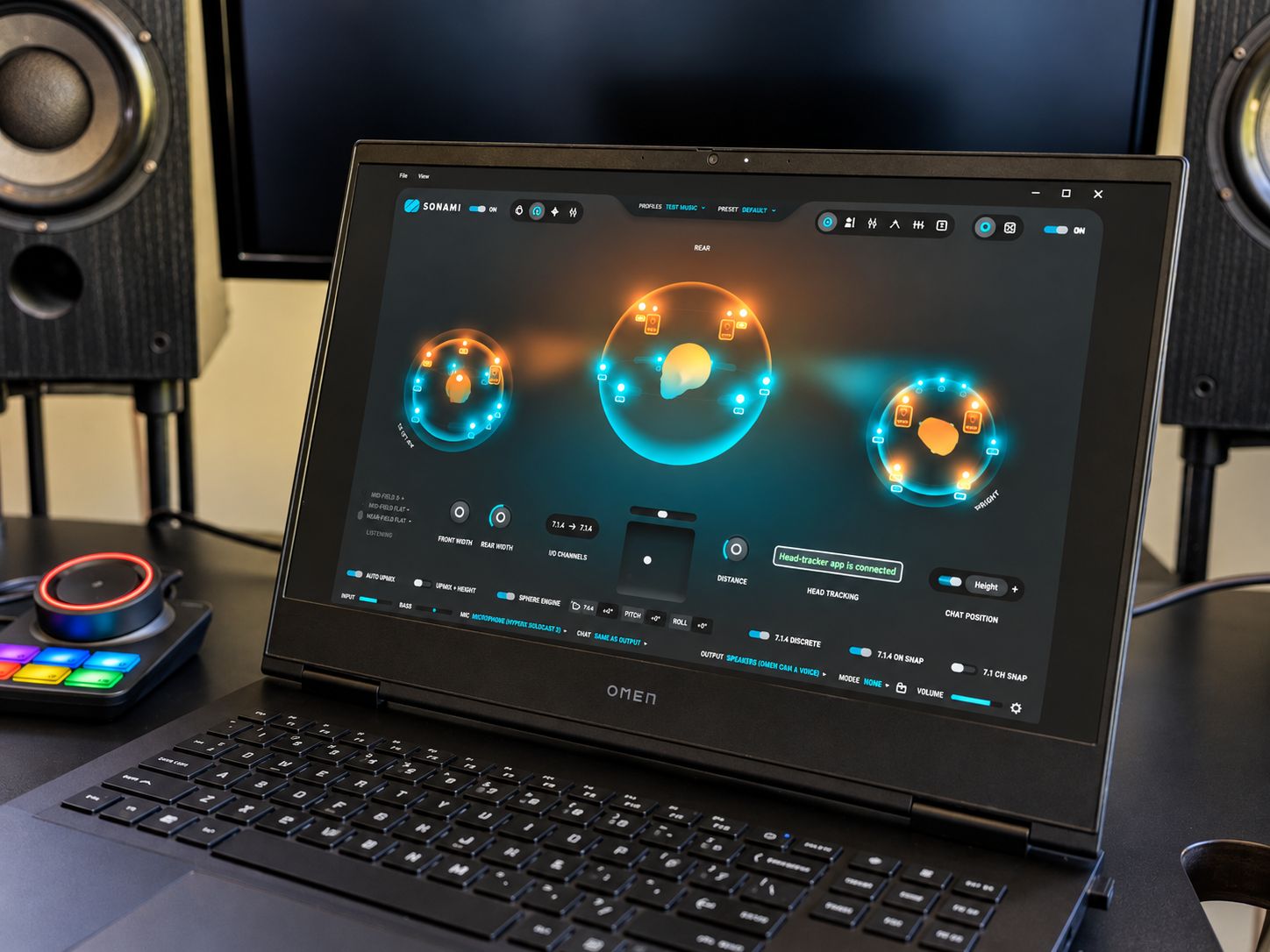
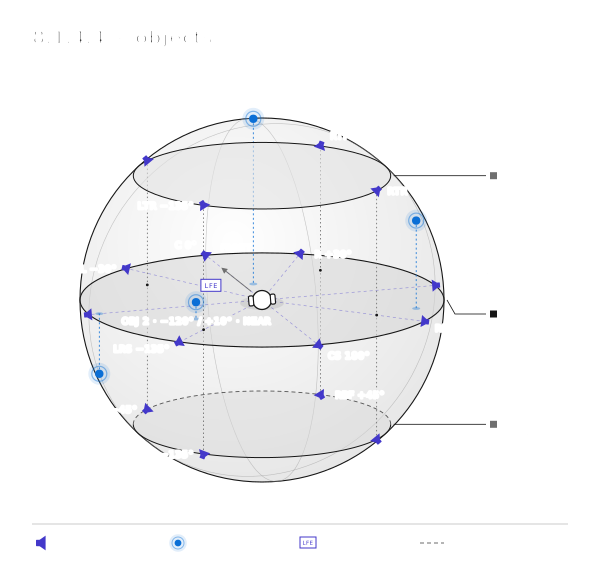
Hear360 binaurally renders everything from stereo to 8.1.4.4 on a virtual speaker array around, above and below the listener's head.
- Upmixing. Stereo becomes surround, extended to 7.1.4 with height channels.
- Channel engine. Stereo, 5.1, 7.1 and 7.1.4 on a fixed virtual speaker array.
- Sphere Engine. A second renderer, built for PHRTF. A configurable 8.1.4.4 bed adds speakers below the ears, plus 64 simultaneous objects placed by direction and distance. Runs in any integration that carries 8.1.4.4, with Windows ISAC support in development.
- PHRTF. Personalized head-related transfer functions for individual head sizes and pinna shapes, rendered through Sphere Engine.
- Head-tracking. World-locked listening driven by camera or headset IMU pose data.
- Spatial chat. Far-end voice input placed at any of 13 positions, overhead included.
- Experiences. Virtual acoustic presets set listening distance and room character.

Output
Studio-grade playback processing
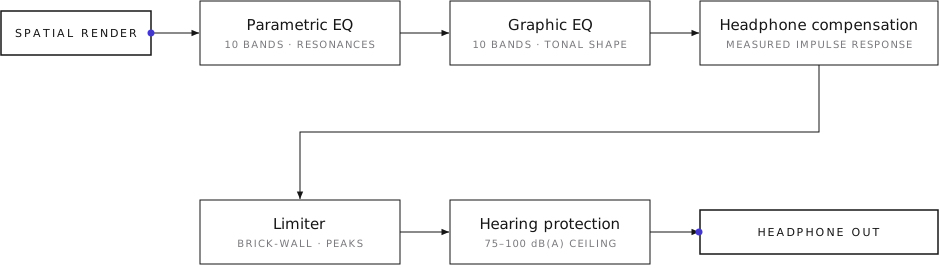
Compensation, EQ and limiting shape the output, with hearing protection at the final stage.
- Headphone compensation. Correction from an impulse response measured on the product.
- EQ. Ten parametric bands for resonances, ten graphic bands for tonal shape.
- Limiting. A brick-wall limiter catches the peaks.
- Hearing protection. Loudness at the ear held under a 75–100 dB(A) ceiling.
Input
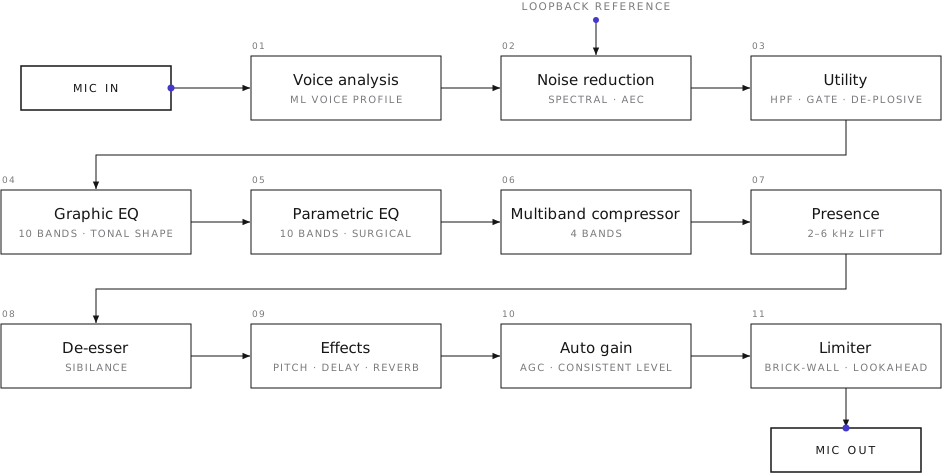
An 11-point voice chain
Cleanup first, tone and dynamics next, level control last. Every stage is enabled and set independently.
- Voice analysis. Machine learning configures the chain from a short speech sample.
- Noise and echo. Neural network or spectral noise reduction, plus acoustic echo cancellation (AEC) with a loopback reference.
- Cleanup. High-pass filtering, and a de-plosive.
- Tone. Graphic and parametric EQ, plus a presence stage.
- Dynamics. Four-band compression, de-essing, automatic gain control (AGC), and a lookahead limiter.
- Effects. Pitch shift, delay and reverb modules.
AI
Neural network voice processing, trained in-house
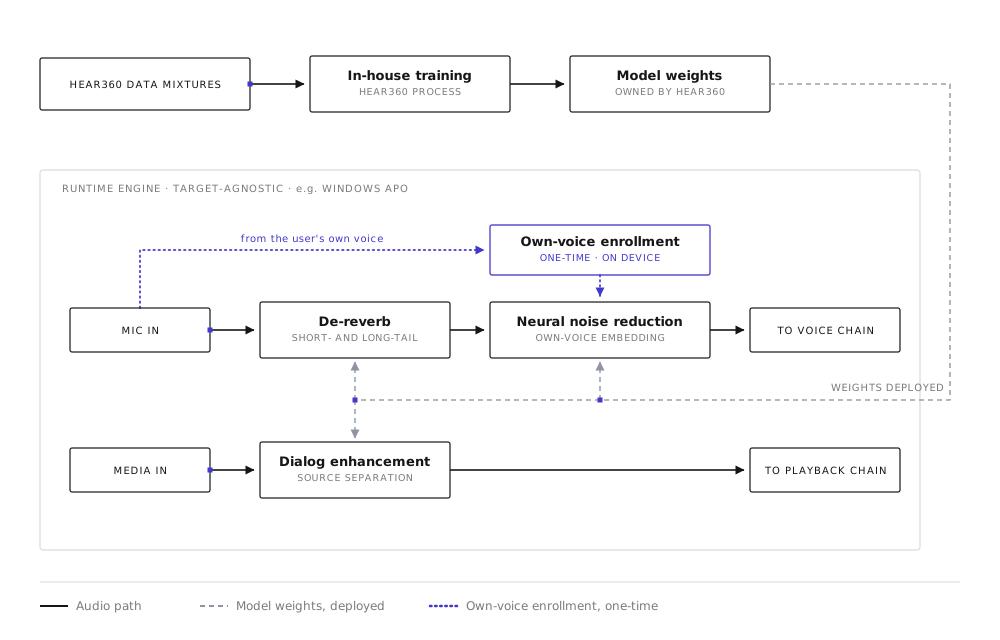
Hear360's own training process and data mixtures produce its model weights.
- Third-party voice rejection. Own-voice embedding keeps the user's voice and rejects other talkers.
- De-reverb. Short- and long-tail reflections removed from the captured input.
- Dialog enhancement. Machine learning source separation lifts dialog by up to 6 dB, with music and effects at their original levels.
Contact us to